
What Is Fireclay? Why It Matters for Large Ceramic Kitchen Sinks
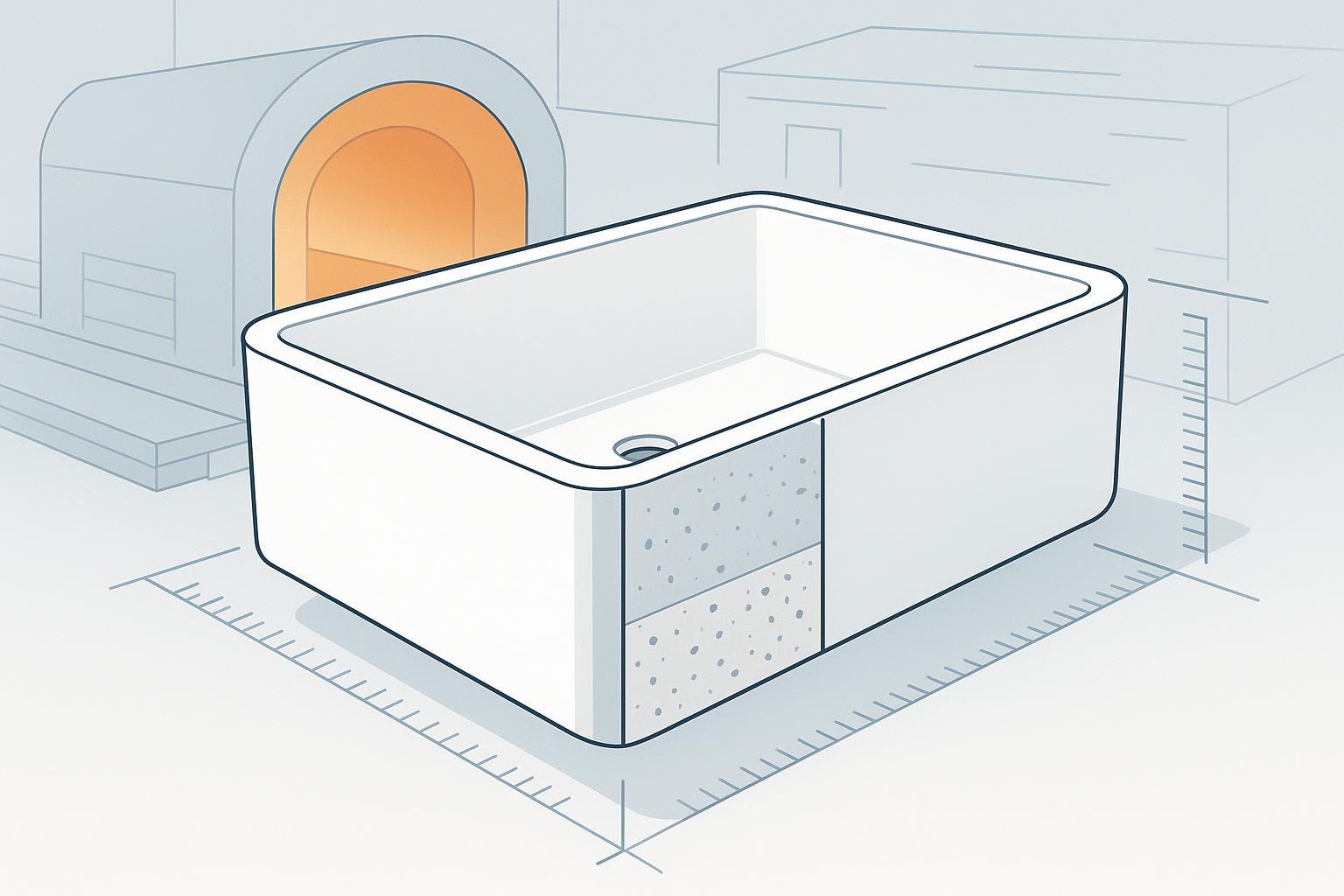
Fireclay—also called refractory clay—is an aluminosilicate ceramic body engineered to withstand high temperatures without slumping. In large kitchen sinks, especially apron‑front designs, its stability at heat helps manufacturers form, dry, and fire big pieces with less distortion.
This executive overview explains what fireclay is and why it matters to buyers. The headline benefit is minimizing warpage and cracking for higher yields and more reliable supply. We also cover durability in daily use and dimensional consistency that makes installation easier.
What is fireclay?
At its core, fireclay is a clay body rich in alumina and silica with low flux content, making it resistant to softening at high temperatures. In ceramics, this “refractory” behavior is why fireclays are used in kiln bricks and heavy‑duty ware. For sinks, that stability creates a wider processing window during forming and firing, which translates into fewer defects and tighter dimensions.
For a technical grounding, an authoritative ceramics resource describes fireclays as clays “resistant to deforming and melting at high temperatures,” often used for refractory items and formulated across alumina–silica systems; see the definition in the Digitalfire glossary in the article on the term fireclay. According to the same body of ceramics knowledge, vitrification at high fire creates dense, low‑porosity ware suitable for sanitary applications. Mullite—a robust aluminosilicate phase that crystallizes as the clay matures—contributes to strength and thermal stability; this phase evolution is summarized in a peer‑reviewed overview of mullite formation available on the NIH/PMC portal.
Reference: Digitalfire’s entry on the term fireclay: see the glossary definition and context in the article fireclay at digitalfire.com.
Reference: A 2021 open‑access review highlights how mullite crystallizes above ~1000–1100 °C and improves mechanical and thermal performance; see the Development and Properties of New Mullite Based Refractory review on the PMC archive.
Industry standards reinforce what “refractory” means in this context. ASTM groups fireclay and high‑alumina refractory brick within a classification that emphasizes heat resistance and compositional classes; see ASTM’s C27 committee overview for context on refractory definitions.
Why manufacturers choose fireclay for large‑format sinks
Large apron‑front bowls are unforgiving. Uneven drying, local softening during firing, or glaze/body mismatch can all turn into twisting, sagging, or cracks. Fireclay helps by giving process engineers more control.
The hero benefit — minimizing warpage and cracking
Material lever: Fireclay bodies tolerate higher temperatures without excessive softening. Manufacturers often include a controlled amount of grog (also called chamotte)—pre‑fired ceramic granules—so the body shrinks more uniformly and resists distortion. Ceramics practitioners have long noted that grog reduces drying and firing shrinkage and interrupts the pathways for warpage. A technical article from Ceramic Arts Network explains how grog’s already‑fired particles act like rigid anchors in the clay matrix, reducing shrinkage variance and improving thermal‑shock behavior. Digitalfire’s troubleshooting notes on warping reinforce the same mechanisms in industrial bodies.
Process lever: With a refractory body, teams can stage drying, equalize wall thickness, and fire to maturity without pushing the body into a “too‑soft” zone. Stable kiln profiles further limit differential heating that drives distortion.
The outcome: fewer cracked or visibly distorted sinks, higher yields, and more dependable deliveries.
Durability in daily use — thermal shock and chip resistance
Thermal shock (think hot pans meeting a cool sink) and everyday knocks are part of kitchen life. As fireclay bodies mature, mullite crystals form within a glassy matrix, improving high‑temperature stability and mechanical strength. The peer‑reviewed mullite review cited above ties this phase to better thermal resistance and rigidity. When paired with a well‑fitted glaze, the dense, low‑porosity body resists water ingress and helps limit chipping from incidental contact.
Dimensional consistency for easier installation
Installers notice when rim widths match drawings and apron faces stay true. Two enablers work together here:
Material: Grog reduces overall shrinkage and, more importantly, shrinkage variability. That narrows the distribution of finished dimensions across a batch.
Process: High‑pressure casting into engineered molds and continuous tunnel‑kiln firing deliver repeatable cycles. Consistency in forming, drying, and peak firing supports tighter dimensions at scale without quoting hard tolerances the supplier hasn’t audited.
Fireclay vs porcelain vs earthenware for buyers
Buyers often ask whether a “fireclay sink” is the same as porcelain—or how it differs from lower‑fire earthenware. Authoritative ceramics references clarify that porcelain bodies are formulated for full vitrification and near‑zero porosity, while earthenware remains more porous unless heavily glazed. Fireclay‑type sink bodies sit in the high‑fire, low‑porosity camp but are engineered with refractory behavior and often include grog for stability. For definitions and property context, see Digitalfire’s entries on porcelain and earthenware and Britannica’s overview of whiteware and porcelain.
Property | Fireclay‑type sink bodies | Porcelain (typical sanitaryware) | Earthenware |
|---|---|---|---|
Firing behavior | High‑fire body with refractory character; often includes grog | High‑fire, fully vitrified to near‑zero porosity | Low‑fire, inherently porous unless glazed |
Porosity at maturity | Low porosity under a fitted glaze | Near‑zero porosity when matured | Medium to high porosity |
Warpage risk profile | Reduced softening tendency; grog limits shrinkage variance | Requires very tight control at peak due to high vitrification | Lower firing temps but insufficient strength for heavy‑duty sinks |
Practical takeaway | Balanced path to large‑format stability and durability | Dense and durable when tightly controlled | Generally unsuitable for large kitchen sinks |
Context sources: Digitalfire’s porcelain and earthenware definitions and Britannica’s porcelain/whiteware overview provide the category‑level distinctions referenced here.
How to specify a fireclay sink body
Procurement shouldn’t prescribe recipes. Specify outcomes and ask for proof.
Request evidence of low water absorption and apparent porosity via ASTM C373 or an equivalent method, reported with test dates and sampling notes.
Ask for fired shrinkage data with ranges and standard deviation across recent production batches of large bowls.
Review dimensional check reports for representative SKUs, including measurement points on rims, aprons, and drain locations.
Confirm forming method (e.g., high‑pressure casting) and mold maintenance practices that keep wall thickness uniform.
Discuss drying and firing controls, including how the supplier measures kiln temperature uniformity and documents profile stability.
Verify glaze fit tests or impact/thermal‑shock summaries; align acceptance criteria to your risk tolerance and application.
According to ASTM’s catalog, C373 measures water absorption, bulk density, and apparent porosity for fired ceramic products. Referencing this standard gives both parties a shared yardstick without revealing proprietary formulas.
Practical example — how an OEM applies these controls at scale
An OEM such as TAITAO can serve as a neutral example of the capabilities that support fireclay outcomes without making performance guarantees here. A production line that combines high‑pressure casting for repeatable forming, staged drying to balance moisture, and a 96‑meter tunnel kiln for stable, zoned firing gives process engineers the levers to reduce warpage and cracking while holding dimensions within target bands. ISO9001‑style quality management further supports batch‑to‑batch documentation—useful when buyers request audited shrinkage distributions, ASTM C373 absorption results, or sample dimensional reports.
FAQs about fireclay sinks
What is fireclay in plain terms? Fireclay is a high‑fired, aluminosilicate ceramic body with refractory behavior—it keeps its shape under heat better than lower‑fire clays. For sinks, that means a wider processing window and a dense, durable, glazed surface.
Is a fireclay sink different from porcelain? Yes. Both are high‑fire ceramics, but porcelain is formulated for near‑zero porosity at maturity. Fireclay‑type sink bodies emphasize refractory stability and often use grog to control shrinkage in large formats. Either can be durable when properly engineered and processed.
How does fireclay handle heat and daily impacts? Mullite development during firing, plus a dense, well‑fitted glaze, underpins good thermal‑shock and chip resistance. As with any ceramic, extreme thermal swings or hard point impacts can still cause damage—ask suppliers for test summaries.
What should I ask a supplier before approving a fireclay sink? Request recent ASTM C373 absorption/porosity results, fired shrinkage statistics, dimensional inspection reports for large models, and a summary of glaze fit and thermal‑shock tests. Also ask about forming method, mold upkeep, drying staging, and kiln uniformity mapping.
Definition and context for fireclay and related bodies are explained by an authoritative ceramics reference; see the Digitalfire glossary article on fireclay for how refractoriness and composition relate to performance: Digitalfire — Fireclay glossary entry.
Mullite’s role in strength and thermal stability is summarized in a peer‑reviewed review with process‑temperature context: Development and Properties of New Mullite Based Refractory (2021), PMC.
The classification context for refractory materials—including fireclay products—is outlined by ASTM; see the committee page: ASTM Committee C27 on Refractories.
Practitioner explanation of grog’s effect on shrinkage, warpage, and thermal‑shock can be found in a technical article: Ceramic Arts Network — Techno File on clay body and grog.
Absorption and porosity testing relevant to sink bodies is standardized in: ASTM C373 — Water Absorption, Bulk Density, and Apparent Porosity.